
Open Source Intelligence (OSINT) refers to the systematic process of gathering, evaluating, and analyzing publicly available information from a wide range of sources to extract meaningful insights and answer specific intelligence queries.
This approach involves harnessing information from publicly accessible platforms such as social media, websites, news articles, online forums, academic publications, and other open resources.
The purpose of OSINT is to analyze information and turn raw data into actionable intelligence that can inform decision-making, investigations, security operations, and strategic planning.
Information versus Intelligence
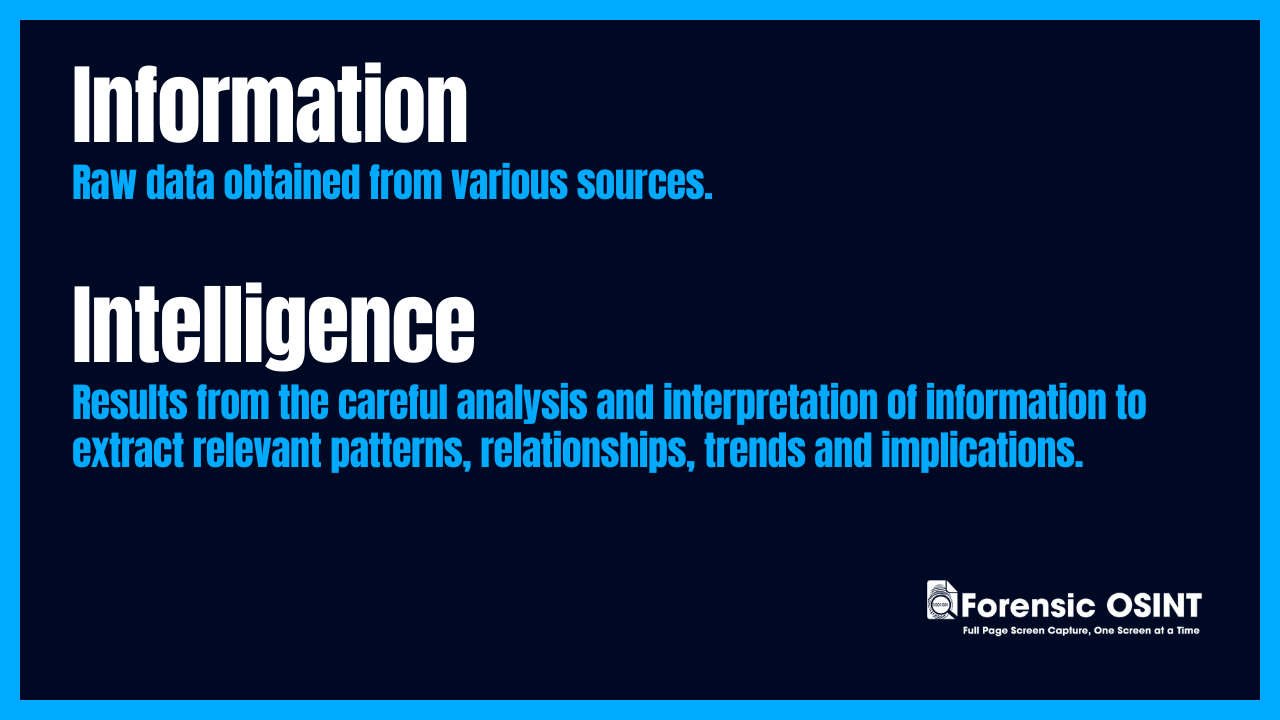
It's essential to differentiate between information and intelligence within the context of OSINT. While information comprises the raw data obtained from various sources, intelligence results from the careful analysis and interpretation of this data.
This process aims to extract relevant patterns, relationships, trends, and implications. In other words, OSINT involves more than just amassing data — it involves applying critical thinking, contextual understanding, and analytical methodologies to transform this data into valuable insights.
For instance, when conducting OSINT, the focus isn't solely on accumulating data points, such as saving a list of Facebook friends. Instead, it's about sifting through information to identify pertinent details that directly address the intelligence question at hand.
OSINT might involve uncovering connections between individuals, tracking the evolution of a particular topic over time, identifying emerging trends, or assessing the credibility of sources. A crucial aspect is understanding the significance of collected data — contextualizing the information, determining its relevance, and discerning how it contributes to a broader understanding of the intelligence objective.
Open Source Information
Open source information encompasses content accessible through a variety of sources, including:
- Public records
- News media
- Libraries
- Social media platforms
- Images and videos
- Websites
- The dark web
Who Uses OSINT?
Open source resources are ingrained in our daily lives, often without us realizing it, and they serve diverse purposes. Open source information is frequently employed by:
Beyond professional use, people use OSINT daily — verifying credibility, researching sellers on Facebook Marketplace, checking out someone from a dating app, or evaluating potential job candidates.
The Intelligence Cycle
The Intelligence Cycle offers a structured framework for effective open source research. While slight variations exist in different versions, its fundamental steps remain consistent:
Preparation
Define the scope, set goals, and identify optimal sources for extracting targeted information.
Collection
Systematically acquire data and information from diverse, pertinent sources.
Processing
Organize and structure the collected material for analysis.
Analysis & Production
Interpret the data, uncover patterns and relationships, and create comprehensive reports.
Dissemination
Present findings through reports, visualizations, timelines, or recommendations.
The Intelligence Cycle serves as a roadmap for the effective execution of OSINT endeavors. Through adept application of the cycle, practitioners can navigate the complexities of open source research, culminating in the delivery of valuable insights to support various operational, strategic, and investigative objectives.
Passive vs Active OSINT
Understanding the difference between passive and active OSINT research is important, as they affect how you interact online.
Passive OSINT
Collecting information from public sources without joining conversations or sending messages. You observe without interacting — watching without talking.
Active OSINT
Direct engagement such as sending friend requests, commenting on posts, or chatting with people online. You become part of the conversation.
Active OSINT is considered engagement and may be viewed as an undercover operation by some organizations. If you're engaging in active OSINT, it's important to look like a regular person, which might mean having online accounts on multiple platforms.
Balancing these approaches depends on clear organizational rules and guidance from leadership.
How OSINT Can Help Your Organization
Advancing Investigations
Provides background information about people and businesses to support criminal investigations.
Source Assessments
Gain deeper insights into human sources by discovering their digital presence and online behavior.
Risk Identification
Identify potential dangers through open information sources for security assessments.
Connecting Dots
Reveal hidden connections between different entities or people.
Smarter Decisions
Provides more information to make better decisions about situations, people, or groups.
Situational Awareness
Find out what is currently happening to help your organization stay prepared.
Conclusion
In an era where information is both a commodity and a weapon, Open Source Intelligence stands as a pivotal tool for organizations and individuals alike. By harnessing publicly available data, OSINT empowers users to make informed decisions, conduct thorough investigations, and stay ahead of emerging trends and threats.
OSINT's applications are broad — from national security to personal safety, corporate strategy to journalistic integrity. Its significance lies in its ability to reveal patterns, connections, and insights that might otherwise remain hidden.
However, with great power comes great responsibility. The ethical considerations of OSINT cannot be understated. Organizations must establish clear guidelines and protocols to ensure OSINT practices are conducted responsibly and effectively, balancing the pursuit of knowledge with respect for privacy, legality, and ethical standards.
OSINT is more than just a set of techniques or a cycle of processes; it's a mindset that encourages critical thinking, curiosity, and a proactive approach to understanding the world around us.